

History and Background of the Book
Published in 2025, this is the follow-up work to Forsgren’s Shingo Award-winning “Accelerate.” Drawing from research with hundreds of software teams across organisations of all sizes, Forsgren and Noda have created a comprehensive guide to removing friction from software development. Forsgren is a renowned DevOps and developer experience expert; Noda founded DX, a company dedicated to measuring developer experience.
What’s the Book About?
The book addresses a critical paradox: despite AI enabling code generation in minutes, many organisations still struggle to ship software efficiently. “Frictionless” reveals that developer experience—systematic removal of friction—is the real bottleneck. It provides a battle-tested 7-step methodology to identify, measure, and eliminate friction across the entire development lifecycle while building the organisational capability to sustain improvements.
Why is it Worth Reading for Leaders?
Enterprise leaders gain a competitive advantage framework. The book provides: (1) quantifiable ROI approaches to translate DevEx improvements into business language; (2) scalable methodology working from 50 to 1000+ engineers; (3) AI integration strategy—how to capture benefits while avoiding new friction points; (4) board-level credibility with metrics suitable for executive presentations; (5) talent retention insights—addressing critical business concerns.
One Sentence Summary of Key Sections
Introduction - AI accelerates code generation, but bottlenecks persist due to friction in the development lifecycle.
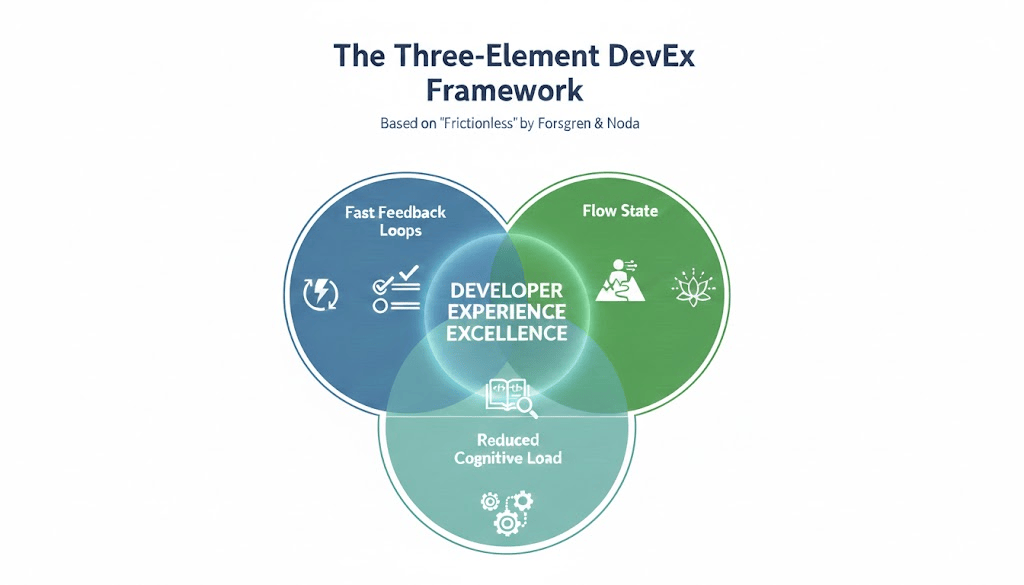
The Three-Element Framework - Fast feedback loops, protected flow state, and reduced cognitive load are the three levers for improving developer experience.
Business Case for DevEx - Frame improvements as recovering time, saving money, accelerating revenue, and solving leadership’s top concerns.Listening to Developers (Step 1) - Conduct 12-15 strategic interviews to identify real friction points before proposing solutions.
Quick Wins (Step 2) - Use Quick RICE methodology to identify high-impact improvements that build momentum and credibility.
Data Collection & Prioritisation (Steps 3-4) - Combine surveys, system metrics, and stakeholder input to systematically identify and rank improvement opportunities.
Communication & Change (Steps 5-6) - Tailor messaging to different stakeholders and match the change strategy to your actual scope of control.
Evaluation & Business Value (Step 7) - Measure impact through appropriate metrics and communicate results in a language stakeholders care about.
Sustaining DevEx - Five practices for making improvements stick: resourcing, change management structures, sustainable technology mindset, and evolving metrics.
Taking Action - Start this week with one developer interview; this month, map your workflow; this quarter, deliver one quick win.
Three Popular Quotes
“When a measure becomes a target, it ceases to be a good measure.” — Goodhart’s Law
This captures why DevEx focuses on removing friction rather than pursuing productivity metrics directly.
“An incomplete measurement is better than no measurement, if you treat it as a clue instead of judgment.” — Jessica Kerr
This reflects the practical approach: perfect data is the enemy of progress; reasonably credible data drives better decisions.
“Developers will gravitate toward tools and workflows with the easiest and most efficient implementation path.” — Sarah Drasner
This encapsulates the core insight: improve experience and adoption happens naturally.
Web Resources
YouTube: “How to Measure and Improve Developer Experience” - Nicole Forsgren keynotes - 40-50 minutes
Podcast: “Engineering Enablement Podcast” - Episode: Ibotta’s DevEx Journey - 35 minutes
YouTube: “Reducing Friction in Software Development” - DX Conference presentations - 45 minutes
Podcast: “The Product Podcast” - Episodes on Developer Experience and Internal Products - 30-40 minutes each
Why no URLs? Because YouTube and Apple change the URL regularly so the links stop working every month—you can look them up easily from the titles.
I know you’re time poor—that’s why I write 3 Minute Skinnies on great books. Each summary takes no more than three minutes to read or listen to, includes compelling quotes, and gives you actionable next steps if you want to take it further.
It is NOT generated by AI.
I use AI for research and input to my thinking - not output